
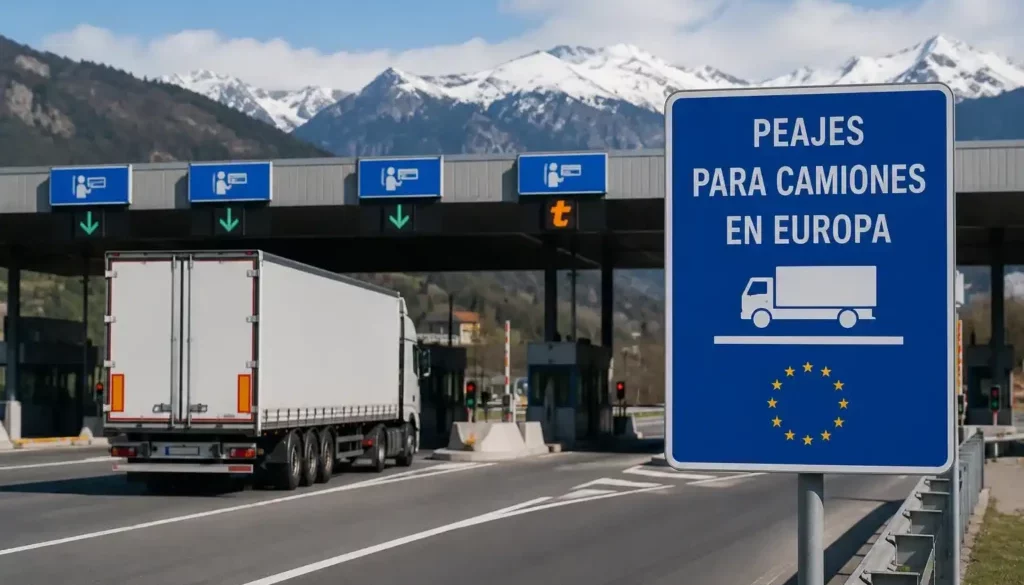
Truck tolls in Europe: Telepass, VIA-T and Toll Collect explained
Managing truck tolls in Europe can become complex when a fleet regularly operates across several countries. There is no single European tariff and no identical toll system on every road. Payment methods, affected vehicles and the information required to calculate each charge may vary depending on the country and the route.
European rules distinguish between tolls based on the distance travelled and vignettes linked to the duration of infrastructure use. Since 2024, tolls and vignettes for heavy-duty vehicles must also vary according to CO₂ emissions.
This makes route planning essential. A transport company needs to check more than the motorways used by each truck. Vehicle weight, number of axles, emission class and on-board unit configuration may also affect toll management.
How truck tolls work in Europe
Truck toll systems are not the same across Europe. Some countries use traditional toll booths, while others rely on electronic charging systems, digital registration or vignettes.
Manual tolls, electronic tolling and digital charging
At a traditional toll booth, the vehicle passes through a toll station and pays the amount linked to the journey. Electronic tolling simplifies this process through a device installed in the vehicle. The system detects the truck and records the charge without requiring a manual payment at each control point.
Other road networks calculate charges through electronic systems linked to the relevant infrastructure. As a result, an international route may require different registrations, configurations or payment arrangements.
Factors that affect the cost
Truck tolls in Europe may depend on:
- distance travelled;
- country and roads used;
- technically permissible maximum laden mass;
- number of axles;
- Euro emission class;
- CO₂ emissions;
- vehicle type;
- correct on-board unit configuration.
A toll estimate should not be based only on the origin and destination. Two trucks travelling along a similar route may generate different charges if their weight, axle configuration or environmental classification differs.
Telepass, VIA-T and Toll Collect: why they are not equivalent
A common mistake is to treat Telepass, VIA-T and Toll Collect as three names for the same product. They actually refer to different operational contexts.
System | Main role | What the company should check |
Telepass | A recognised electronic toll payment reference for certain European routes | Available coverage, correct vehicle association and configuration |
VIA-T | Interoperable electronic tolling system used on Spanish toll motorways | Device position, enabled lanes and issuer conditions |
Toll Collect | German toll system for vehicles subject to road charging | Weight, axles, emissions, roads used and registered data |
EETS | European framework designed to improve interoperability between electronic toll systems | Countries included, service activation and route requirements |
The right choice depends on the fleet’s actual operation, not only on the system name. A toll solutions specialist should assess the countries travelled through, route frequency and technical details of each vehicle.
Telepass for trucks
Telepass is a recognised name in electronic toll payments for heavy vehicles in Italy and across European routes. Its suitability should be assessed according to the fleet’s operating model. A company running domestic routes does not have the same requirements as a fleet crossing several borders every week.
Before assigning a device, the company should check:
- vehicle and registration number association;
- activated territories;
- truck category;
- countries included in the route;
- frequency of travel;
- required billing and documentation.
A device should not automatically be treated as a universal solution. Coverage and activation must be confirmed before the journey starts.
VIA-T for trucks in Spain
VIA-T is the interoperable electronic tolling system implemented on Spanish toll motorways. It allows vehicles to pay without stopping by using an electronic device installed on the windshield. An antenna reads the device data and charges the amount to the linked account or card.
For truck fleets, the main advantage is operational efficiency. Drivers can use enabled toll lanes without making a manual payment at each stop.
Correct installation is important. The VIA-T device must be placed on the windshield according to the relevant instructions. Incorrect positioning may prevent communication with the antenna and cause problems at the toll station.
VIA-T can also be used on certain motorways outside Spain. The company should confirm the precise scope of the service before planning an international route.
Toll Collect in Germany
Germany requires particular attention when planning European transport routes. Since 1 July 2024, vehicles intended or used for road haulage with a technically permissible maximum laden mass of more than 3.5 tonnes have been subject to German tolls, except where an exemption applies. The system covers motorways and federal trunk roads.
The calculation takes technical vehicle data into account. Toll Collect explicitly lists the CO₂ emission class, Euro emission class, axle class and weight class among the factors used to determine the charge.
Before operating in Germany, a company should check:
- technically permissible maximum laden mass;
- number of axles;
- registration number;
- Euro emission class;
- CO₂ emission class;
- associated device or registration;
- consistency between declared data and the vehicle used.
Incorrect configuration may affect the calculation and create administrative issues.
What EETS means for international routes
EETS stands for European Electronic Toll Service. Its objective is to improve interoperability between electronic road toll systems in the European Union. European rules establish the technical conditions required to support more coordinated toll management.
The practical benefit is clear. An international fleet needs to reduce the administrative burden created by operating across different national toll systems. The European Commission states that interoperable electronic tolling systems reduce the costs and burdens for users caused by the coexistence of different tolling systems across the EU.
This does not mean that every device automatically works on every European road. Companies still need to confirm activated territories and the configuration required for each truck.
How to simplify fleet toll management
The most suitable solution depends on the company’s actual routes. A fleet operating mainly in Spain may have different needs from one that regularly crosses France, Italy and Germany.
A specialist in the sale and configuration of electronic tolling systems can help to:
- identify the countries included in regular routes;
- select the right configuration for each truck;
- review weights, axles and emission categories;
- reduce administrative errors;
- organise documentation;
- simplify billing;
- avoid unnecessary devices.
The company can review the available motorway toll payment services to identify a solution suited to its regular routes.
Checklist before sending a truck on a European route
Route
- countries crossed;
- toll motorways and roads;
- possible itinerary changes;
- systems required in each territory.
Vehicle
- registration number;
- technically permissible maximum laden mass;
- number of axles;
- Euro emission class;
- CO₂ emissions;
- transport type.
Device
- correct installation;
- association with the assigned vehicle;
- activated services;
- operating status;
- documents available to the driver.
Internal management
- billing;
- journey records;
- incidents;
- data updates when the route or vehicle changes.
Conclusion
Truck tolls in Europe should not be managed as an isolated administrative task. They form part of route planning. Telepass, VIA-T and Toll Collect serve different operational contexts, while EETS helps explain how interoperability can make international journeys easier to manage.
The most effective approach is to review each fleet individually: countries covered, route frequency, weight, axles and emissions. Based on these details, a specialist company can propose a simpler configuration and reduce unnecessary administrative work.
Frequently asked questions about truck tolls in Europe
Do all trucks pay tolls in Europe?
There is no single rule that applies to every European road. The country, road network and vehicle characteristics determine whether a toll applies and how it is calculated.
What is the difference between Telepass, VIA-T and Toll Collect?
Telepass is a recognised electronic toll payment reference for certain European routes. VIA-T is the interoperable electronic tolling system implemented on Spanish toll motorways. Toll Collect manages the German road charging system for vehicles subject to tolls.
Which trucks must pay Toll Collect charges in Germany?
Since 1 July 2024, vehicles intended or used for road haulage with a technically permissible maximum laden mass of more than 3.5 tonnes have been subject to the toll, except where an exemption applies.
Do CO₂ emissions affect toll prices?
Yes. European rules require tolls and vignettes for heavy-duty vehicles to vary according to CO₂ emissions.
Can a single device be used throughout Europe?
This should not be assumed. Interoperability has improved, but the company still needs to confirm activated countries, coverage and vehicle configuration before each route.